| Home > Argentina |
ARGENTINA:
Country Profile of Argentina
Argentina is a country in southern South America. It ranks second in land area in South America, and eighth in the world. Argentina occupies a continental surface area of 2,766,890 km² (1,078,000 sq mi) between the Andes mountain range in the west and the southern Atlantic Ocean in the east and south. It is bordered by Paraguay and Bolivia in the north, Brazil and Uruguay in the northeast, and Chile in the west and south. The country claims the British controlled territories of the Falkland Islands (Spanish: Islas Malvinas) and South Georgia and the South Sandwich Islands. Under the name of Argentine Antarctica, it claims 969,464 km² (374,312 sq mi) of Antarctica, overlapping other claims made by Chile and the United Kingdom.
The country is formally called the Argentine Republic. For many legal purposes, Nación Argentina is used.
| ☻Capital: - Buenos Aires ☻Area: - Total: 2,766,890 km² (8th) 1,073,514 sq mi - Water (%): 1.1 ☻Independence: - May Revolution: 25 May 1810 - Declared: 9 July 1816 - Recognized: 1821 (by Spain) |
☻Official languages: - Spanish ☻Population: - 2013 estimate 41,660,417 - 2010 census 40,117,096 - Density 14.4/km² - 37.3/sq mi |
Geography of Argentina:
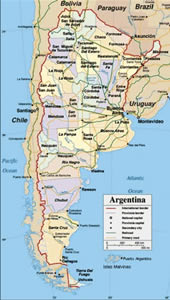 The second largest country in South America after Brazil is Argentina. It is located in between the Andes mountains which are situated to the west and the Atlantic Ocean which is over to the east. Paraguay and Bolivia border Argentina in the north, with Brazil and Uruguay in the northeast and Chile to the west. The total area in size is approximately 2.7 million km. Several islands that are administered by the United Kingdom are claimed by Argentina along with certain sections of Antarctica. Buenos Aires, is the largest city in Argentina with a population of roughly 13,000,000 people. This beautiful city makes up most of the population, the economic and the agriculture production in the country. Five regions make up the country of Argentina. The Pampa region is in the central-eastern part of the country that makes up a large portion of the intense agriculture activity. Mesopotamia is a warm subtropical climate that is hosts subtropical forests and the watershed that is made up by the Uruguay and Paraná rivers. Up towards the northeast is the land of the Argentinean Chaco which overflows with forest and wood. Down towards the northwest is more mountainous soil with minerals and a climate that is much like one of the desert. Cuyo is a region made up of fertile mountains and an abundance of minerals and thermal springs. Lastly there is Patagonia which is very famous for its hiking and its breathtaking landscape. This upland is located towards the south of Argentina and is made up of forests, glaciers and crystal lakes.
 Education in Argentina:
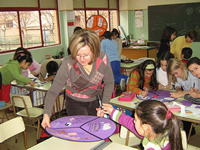 Contrary to other countries in South America, the educational system in Argentina is by far the best in Latin America and one of the best in the world. It is the law in Argentina that all children between the ages of six and fourteen must attend school. Everyone is given free education and is surely cause for why the literacy rate is over 95 percent. There are public and private schooling available at both primary and secondary levels and as is the normal for South America, city areas receive better education and educational supplies than those located in rural areas. In 1993 the Argentina school system changed from seven years of primary schooling and fiver years of secondary school to a new system called EGB. EGB requires that students go to school for nine compulsory years separated into three-year stages. Higher education is also one of the best in South America with nearly 70 institutions divided both privately and publicly. Public universities in Argentina are free of charge which gives students the chance to expand their education without having to worry about the cost. Individuals who attend and finish university in Argentina have one of the highest percentages in the world next to France.
 Health in Argentina:
Compared to many other South American countries, Argentina has a more favorable health and medical care system. The department of Public Health, an agency of the Ministry of Social Welfare oversees the National health policy in Argentina. Over 79 percent of the population has access to safe drinking water with 85 percent of the people having adequate sanitation throughout the country. Most of the major infectious diseases that once infected the country have been reduced greatly or completely eliminated. In the year 1999, medical cases of Tuberculosis were down 47 percent from 20 years previous. Healthcare flourishes in Argentina due to unions providing Health and medical services for workers. Most employers are also required to give free medical and pharmaceutical care for employees that are injured. With these initiatives taking place in the country, healthcare quality is and has been on the rise. Health immunizations for children have helped greatly in preventative healthcare for the people of Argentina. Life expectancy in Argentina is fairly high as well with an average of women living to 79 years with men living till 71. Unlike other countries in South America, it is safe to drink water from the tap in larger cities and towns in Argentina. Access to safe drinking water does diminish outside of the more populated areas.
Politics in Argentina:
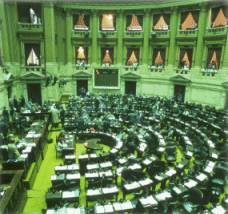 Argentina has a long history when it comes to its politics and government. Though Argentina has a representative democracy, it was not always the case. After the French Revolution and the American Revoluntionary War, in 1810 Buenos Aires formed its own military. Though it still took several more years, Argentina finally gained its independence from Spain in 1816. Over the past two centuries, the government has changed and grown through wars and treaties, numerous presidents and changes in democracy. Dictatorship took over the country though the presidency of Jorge Rafael Videla which began in 1976. After the defeat of the Falklands/Malvinas war in 1983 a democratic election was finally won by President Raul Alfonsin. He resigned in 1989, 6 months prior to the end of his term. Carlos Menem served as president, placing the country in danger of being under a dictatorship government once again. He served for 6 years and had a constitutional reform created that would allow him to be reelected. Following a neoliberal program, Menem ruled for four more years, until 1999, when Fernando de la Ruá was elected. This was the first time in decades that an Argentine president properly finished his term and passed on his charge to another democratically elected president. In the early years of the 21rst century, Argentina saw a tough time in the economy. Provoked as well by riots, the country saw many interim presidents that came and went through the first few years. Nestor Kirchner of the Justicialist Party was finally chosen as president through a ballotage system in May of 2003.
In 2007 he stepped down to allow his wife Cristina Fernández de Kirchner to win election in his place. Kirchner is Argentina's first elected female president. In 2011 she was re-elected, obtaining 54.1% of the vote.
When hearing about Argentina, one has to tell the story of Eva Peron a.k.a, Evita. Eva Peron was married to Juan Peron, president of Argentina, during the 1940´s. The city of Buenos Aires adored her and her husband for the progress they were making for the country during this time. A woman who had many visions for the country of Argentina, she stood by her husband as he went on to become one of the most admired and maligned leaders of the modern era. Eva Peron was a woman who believed passionately in women´s rights, charity and social causes bringing her the fame and esteem that she deserved.