| Home > Peru |
PERU:
Country Profile of Peru
The Republic of Peru is a country in western South America, bordering Ecuador and Colombia to the north, Brazil to the east, Bolivia to the south-east, Chile to the south, and the Pacific Ocean to the west.
In addition to being known as the cradle of the Inca empire, Peru is the home of many indigenous ethnic groups, and it was the seat of the Viceroyalty of Peru, with jurisdiction over all of Spanish South America.
In addition to being known as the cradle of the Inca empire, Peru is the home of many indigenous ethnic groups, and it was the seat of the Viceroyalty of Peru, with jurisdiction over all of Spanish South America.
|
☻Capital: - Lima ☻Area: - Total: 1,285,220 km² (20th) 496,222 sq mi - Water (%): 8.80 ☻Independence: from Spain - Declared: 28 July 1821 |
☻Official languages: - Spanish, Quechua, Aymara ☻Population: - July 2005 census: 27,968,000 (41st) - 2005 census: 27,219,266 - Density: 22/km² (183rd) 57/sq mi |
Geography of Peru:
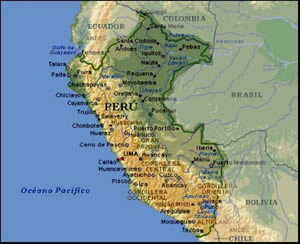 Peru is 34 times larger in size than Holland (about as big as Scotland), with a population of about 28 million. The most important cities are Lima (9 million inhabitants – about one third of Peru’s population), Arequipa (1 million), Trujillo (500,000) and Cusco (350,000). More then 65% of the population live in urban regions throughout the cities.
 The three major geographic regions in Peru are the costa (mostly desert), sierra (mountains) and selva (jungle). All of these districts are culturally separated; they have their own languages, development, history, population, customs, etc.
These separations affect the development and infrastructure in the various regions. For example, you will only find asphalt roads along the coast and in around cities like Arequipa, Huaraz, Puno and Cusco.
Most of the infrastructure, money and important resources are concentrated in Lima. Country decisions are usually made from Lima as well and frequently based on perceptions of a big modern city. Unfortunately, for this reason, the outside communities and their needs are not always taken into account.
Education in Peru:
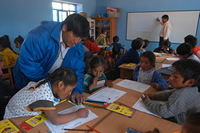 The quality of education in Peru is unfortunately, not the best. Teachers, especially the older ones, commonly use very old-fashioned teaching methods. Children are mostly taught to copy and memorize, but are not stimulated to be creative and come up with their own ideas. This type of education is quite recognizable throughout the country in other facets as well. How many of the restaurants in this city center offer something different than the others? Why do all the tour operators promote themselves in the same manner and why do all street sellers offer the same goods? There may be different explanations for this type of lifestyle though the most likely scenario is the education standard and format of teaching in Peru.
Apart from the teaching method, there are other problems regarding the education:
Although nearly 100% of the children are officially administered in an elementary school in Peru, many of children do not attend school or they are only able to go for a few years. School attendance is obligatory, but there is no one who really supervises or monitors those who are absent. One of the reasons for this high inscription percentage is that enrolled children receive insurance, but many children drop out afterwards. When someone in the family is ill, children often have to stay home to watch after their ill family member and medical expenses do not allow children to have school supplies at home.
Children from poor families are very often tired, underfed, and aggressive and for that reason they cannot concentrate. Some parents are illiterate or do not speak Spanish, so they are unable to help their children with home work.
In order to enter secondary school or university, you need to pass a specific exam. Due to these various factors, hardly anyone from the mountain villages enters. Secondary school is completed by 88% of all men and only 77% of all women. Urban women complete about 8.3 years of education, and in rural areas, women complete only 3.7 years. The minimum number of years of education expected in order to further alleviate the chances of poverty are 10 years according to calculations by the United Nations.
There is a big difference between private and public schools in Peru. Families who can afford higher expenditure will send their children to a private school because the quality of education is greater. Children that attend public school spend only half a day in classes, which amounts to about 400 hours per year. In rural areas class attendance is much less with students spending 200-250 hours in the classroom per year. Children that go to private schools in Peru receive 1,100 hours of education with the comparison of attendance being about 1000 hours a year in Holland. A problem that often occurs (especially in rural areas) is faulty teacher attendance due to many professors living far away. Commute times are long which adds to classes beginning later. Teachers are often paid very low salaries and often times have a second job in addition to teaching in order to live a more secure life. Due to the fact that the government is in charge of constructing the local buildings and overseeing payment given to the teaching staff, schools are low stocked when it comes to necessities needed in the schools themselves.
Health in Peru:
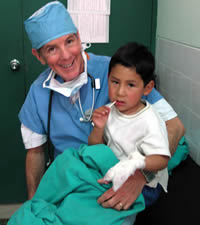 Good quality healthcare is not available to everyone in Peru. People, especially in rural areas, have to go travel great distances in order to receive medical treatment. In the cities, including Cusco, there is a big difference between public and private healthcare. A bill from a clinic can cost over 200 soles which is very difficult for most Peruvians to pay.
At least, children that go to school are insured, and women also receive free or cheap treatment in various medical centers.
Only 77% of the population has access to safe drinking water and only 76% has access to sanitation. Malnutrition occurs very often with an average of 25% of the population, namely in the more rural regions. Many children die within their first years, and pregnant mothers are not immune to mortality expectancy while giving birth. In small villages in the mountains, women give birth to their children at home with the help of neighbors. A woman often lies down on a sheep skin to reduce the pain and the umbilical cord is cut with a roof tile. The women usually do not wash their baby immediately after birth, and only later they give their child a name. When the child reaches 2 or 3 years old, mothers will officially register him or her because the death rate is relatively high. As a result, many children will not know their exact birth date nor have their official documents needed for later years in life.
Politics in Peru
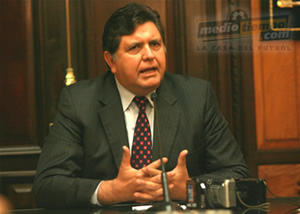 From a political standpoint, Peru is a very complicated country. To give a bit of background, when president Fujimori reined power in 1990, Peru was near bankruptcy due to former president Alán García. García decided to stop paying back foreign debts as he thought Peru was incapable of doing so, and thus all international loans and investments were frozen and Peru lost more money. At the same time, Sendero (Sendero Luminoso, Lightning Path, Maoist Guerilla, a terrorist group that began in Ayacucho) was gaining power and the future of Peru seemed very unsteady.
 Despite these problems, Fujimori succeeded in placing the leader of the Sendero (Abimael Guzman) behind bars with help from the National Central Intelligence Agency, which meant the end of the Lightening Path. Little by little, Peru was able to start reconstruction, though many false promises were made. Fujimori changed the constitution so that he could remain in power for more than the usual two periods (of five years). He got re-elected twice: in 1995 and in 2000. During the election in 2000, he ran a seemingly corrupt campaign against Alejandro Toledo, and lost support when a video emerged with his right-hand Montesinos bribing an important business man for $15,000. The result of this scandal led Fujimori to flee to Japan.
Toledo won the new elections in April 2002. Once a shoe shiner, he was the first Quechua-speaking president of Peru. He managed to reach an average economic growth of 4%, even though more than 50% of the Peruvians still lived in poverty.
Just like his predecessor, Toledo ended up in the middle of several other corrupt scandals. Public support went from 59% down to only 6% showing an absolute negative record.
In 2006 Alan Garcia once again won the elections, defeating nationalist candidate Ollanta Humala, who was very popular in the Cusco region. Ollanta now faces several trials for his role in the army fighting Sendero Luminoso. He was allegedly accused of abusing human rights which included forced disappearances, torture, and murder. He is denying those facts, stating that the charges were ‘orchestrated by the Alan Garcia administration to neutralize any alternative to his power’. Meanwhile Fujimori, who has been captured in Chili while trying to enter Peru for the 2006 elections, is awaiting trial.
Up until now Garcia has strengthened economic ties with Chili and Brazil which has brought success to many people in Peru. However, he has faced his first major political defeat in January when his proposal of the death penalty for members of the Shining Path was blocked by the Congress.